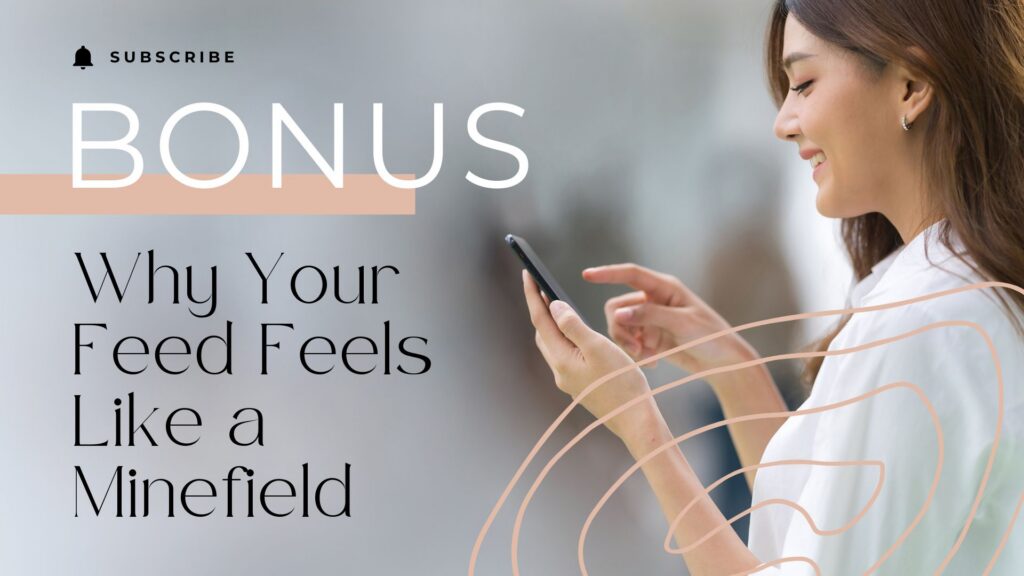
If your social media feed has felt overwhelming lately, you are not alone. Between graphic news footage, disturbing document releases, and emotionally charged content appearing with zero warning, scrolling through Reels has started to feel less like entertainment and more like an emotional minefield. In this bonus episode, I explore what the latest research reveals about social media brain health, and I share five strategies you can use to protect your brain starting tonight.
I originally wrote a blog post about this topic. When I tried to publish it on Facebook, it was flagged and blocked multiple times. So I brought it here instead, along with powerful new research that has come out since then. This episode covers the science behind short-form video and your brain, why this matters especially for women in perimenopause and menopause, and practical steps to take back control of your scrolling habits.
Listen to This Episode
What We Cover in This Social Media Brain Health Episode
This episode unpacks the real science behind what short-form video does to your brain. Here is a summary of what you will learn:
The dopamine scroll loop. Short-form videos deliver fast, frequent bursts of dopamine. Each swipe signals that something new might be waiting, and your brain gets a small reward hit every time. Over time, this creates an addictive loop that makes it harder to disengage. Dr. Daniel Amen has explained that dopamine overstimulation is associated with agitation, obsessive behavior, and cognitive fog.
The largest meta-analysis ever conducted on this topic. In 2025, researchers published a landmark study in Psychological Bulletin analyzing 71 studies and 98,299 participants. They found that higher short-form video use was linked to moderate declines in overall cognitive performance, with the strongest negative associations in attention and impulse control. These findings held true across age groups, confirming that social media brain health concerns are not limited to teenagers.
Structural brain changes. A separate neuroimaging study published in NeuroImage found increased gray matter volume in the orbitofrontal cortex and cerebellum of heavy short-form video users. The brain is physically reshaping itself around the scroll.
“Brain rot” is more than slang. Oxford University Press named “brain rot” their Word of the Year for 2024. Its usage increased 230% in a single year. While it started as internet humor, the research behind it is substantial.
The menopause and ADHD connection. Estrogen decline during perimenopause and menopause already affects cognition, mood, and sleep. Layering heavy short-form video use on top of these hormonal shifts compounds the problem. An ADDitude Magazine survey found that 94% of women with ADHD reported that menopause worsened their symptoms. Short-form video exploits the exact vulnerabilities these women already face.
Emotional whiplash and memory. Rapid emotional context-switching while scrolling harms the hippocampus and degrades prospective memory. Research shows this affects your ability to retain intentions and follow through on planned actions. This matters for social media brain health because it means scrolling can impair your real-world functioning.
5 Strategies to Protect Your Brain Health
You do not have to delete your apps. However, you do need to scroll with intention. Here are five strategies from this episode:
1. Use a Pomodoro Timer
Work for 25 minutes, then take a 5-minute break. The break can include watching a few Reels. The key is that a timer creates a boundary so you decide when you scroll, not the algorithm. I use a simple Pomodoro timer that sits on my desk, and it has been a game-changer for my social media brain health.
2. Set App Time Limits
Both iOS and Android have built-in screen time settings for specific apps. Instagram and Facebook also have their own usage reminders. Start with whatever feels realistic. Most people are genuinely shocked when they see their actual screen time data.
3. Curate Your Feed and Use Content Filters
Unfollow or mute accounts that leave you feeling stressed or emotionally drained. Follow creators who educate and inspire. Every like, comment, and share trains your algorithm.
Most platforms also have content filtering settings where you can enter keywords for topics you do not want to see. TikTok does a decent job with this feature. Instagram and Facebook are less reliable. I have entered keywords on both and the content still comes through. It is worth setting up, but do not rely on it as your only line of defense.
4. Protect Your Sleep with the 3-2-1 Rule
Three hours before bed, finish eating. Two hours before bed, stop working. One hour before bed, power down all screens. This is not just about blue light. It is about giving your brain time to transition from stimulation to rest. Lavender aromatherapy, journaling, and reading a physical book are all great screen-free alternatives.
5. Reintroduce Long-Form Content
Add podcasts, books, long-form articles, or longer videos back into your routine. Think of it as physical therapy for your attention span. Your brain adapted to short-form content, and it can adapt back. Even ten minutes of sustained reading or listening per day can begin retraining your brain for deeper focus. This is one of the most powerful things you can do for your social media brain health.
Research and Studies Cited
Here are the key studies and sources referenced in this episode, so you can explore the research for yourself:
Nguyen, L., Walters, J., Paul, S., et al. (2025). “Feeds, Feelings, and Focus: A Systematic Review and Meta-Analysis Examining the Cognitive and Mental Health Correlates of Short-Form Video Use.” Psychological Bulletin, 151(9), 1125-1146. Read the study on PubMed
Gao, Y., et al. (2025). Structural brain changes in heavy short-form video users. NeuroImage. Gray matter volume increases in the orbitofrontal cortex and cerebellum. Coverage on PsyPost
Liu, C., et al. (2025). Short-video addiction and loss aversion: a gambling task study. NeuroImage. Reduced sensitivity to financial losses mediated by decreased precuneus activity.
Oxford University Press (2024). “Brain Rot” named Word of the Year. 230% usage increase from 2023 to 2024. Read the announcement
De, D., et al. (2025). “Social Media Algorithms and Teen Addiction: Neurophysiological Impact and Ethical Considerations.” Cureus. Read on PubMed Central
Jiang, Z., & Ma, Y. (2024). Brief TikTok exposure reduces analytic thinking, promoting intuitive, low-effort processing.
ADDitude Magazine. Survey of 1,500+ women with ADHD: 94% report menopause worsens symptoms. Read on ADDitude
Mark, G., Gudith, D., & Klocke, U. (2008). UC Irvine. Workers take an average of 23 minutes and 15 seconds to refocus after a context switch. Read the study (PDF)
Satani, D., et al. (2025). “Modern Day High: The Neurocognitive Impact of Social Media Usage.” EEG study measuring real-time brain activity changes during social media use. Read on PubMed Central
Cognition, Mood, and Sleep in Menopausal Transition. Medicina, 2019. Read on PubMed Central
Resources Mentioned in This Episode
Pomodoro Timer (Amazon) – The simple timer I use to set boundaries around scrolling and focused work.
Change Your Brain Every Day by Dr. Daniel Amen (Amazon) – Daily practices to strengthen your mind, memory, and focus.
Brain Wash by Dr. Austin Perlmutter & Dr. David Perlmutter (Amazon) – A guide to detoxing your mind from digital overload.
Connect with Kristen
Instagram: @kristenjbeasley
Website: healthylifeapproach.com
Final Thoughts on Social Media Brain Health
You do not have to choose between staying connected and staying healthy. The key is awareness and intention. Once you understand how short-form video affects your brain, you can make choices that protect your cognitive health without giving up the platforms you enjoy.
If this episode resonated with you, I would love for you to share it with someone who needs to hear it. Every share helps this podcast reach more women who deserve this information. Taking care of your social media brain health is not about perfection. It is about making small, intentional changes that add up over time. You are not too late, you are not too old, and you are absolutely not powerless. You are the CEO of your health, and every small step counts.
Medical and Affiliate Disclaimer: I am not a licensed medical professional. The information shared in this post and episode is for general educational purposes only and is not intended to substitute for professional medical advice, diagnosis, or treatment. Always seek the advice of your physician or other qualified health provider with any questions you may have regarding a medical condition. This post contains affiliate links. As an Amazon Associate and affiliate for different brands, I earn from qualifying purchases at no additional cost to you.